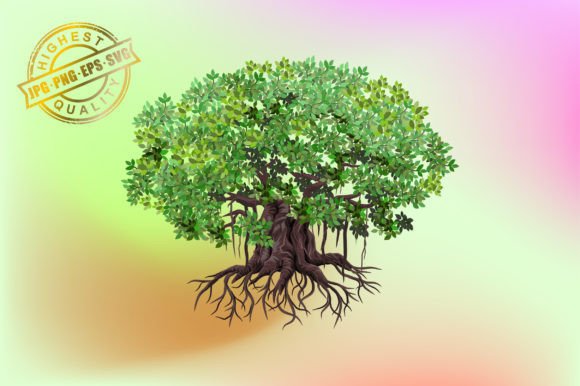
Evaluating the Banyan Tree and Roots Vector for Design Projects
In the realm of digital design, the choice of visual assets can significantly influence the aesthetic and functional quality of a project. Among the myriad of resources available, the Banyan Tree and Roots Vector has emerged as a versatile option for designers, crafters, and content creators. This asset is not merely a static image but a comprehensive set of high-quality files designed to integrate seamlessly into various creative workflows. Understanding the specific attributes, file formats, and practical applications of this vector set is essential for determining whether it aligns with your current design objectives.
Understanding the Asset and Its Composition
The Banyan Tree and Roots Vector is a digital graphic resource that captures the intricate details of a banyan tree, focusing particularly on its expansive root system and canopy. Unlike raster images, which are composed of pixels and can lose clarity when resized, vector graphics are based on mathematical paths. This fundamental difference means that the Banyan Tree and Roots vector can be scaled to any dimension—from a small icon to a large-format banner—without suffering from pixelation or loss of quality. This scalability is the primary technical advantage that makes vector assets indispensable for professional design work.
The download package typically includes multiple file formats to ensure compatibility across different software and use cases. These usually consist of JPG files for quick previews or web use where transparency is not required, PNG files for designs needing transparent backgrounds, and EPS10 and SVG files for full editability in vector-based programs. The inclusion of EPS10 ensures compatibility with older versions of Adobe Illustrator and other industry-standard tools, while SVG is ideal for web development and modern design applications.
Practical Applications and Use Cases
One of the strongest arguments for acquiring the Banyan Tree and Roots Vector is its adaptability. The organic, complex lines of a banyan tree lend themselves well to a variety of design contexts. For branding and logo design, the tree can symbolize growth, stability, and interconnectedness. Businesses in sectors such as environmental conservation, wellness, yoga studios, or educational institutions may find this imagery particularly resonant with their brand values. The ability to isolate specific elements, such as the roots or the leaves, allows for the creation of unique icons or simplified logos that maintain visual interest without overwhelming the viewer.
Beyond corporate branding, this vector set is highly suitable for DIY crafts and physical products. The clean lines of the vector template make it an excellent candidate for vinyl cutting, laser engraving, and screen printing. For instance, t-shirt designers can utilize the SVG or EPS files to create detailed prints that remain crisp regardless of the garment size. Similarly, home decor enthusiasts might use these files to create wall decals, wooden signs, or paper cutouts. The versatility extends to digital media as well, where the assets can serve as background elements for websites, blog headers, or social media graphics, adding a touch of natural elegance to digital interfaces.
Benefits of Using Vector Formats
The primary benefit of using the Banyan Tree and Roots vector lies in its editability. Because the files are openable and editable, designers are not restricted to the original composition. Colors can be adjusted to match specific brand palettes, elements can be rearranged, and unnecessary details can be removed to simplify the design. This level of control is crucial for maintaining consistency across a marketing campaign or a product line. Furthermore, vector files are generally smaller in file size compared to high-resolution raster images, which can improve website loading times and reduce storage requirements.
Another significant advantage is the longevity of the asset. Design trends change, but a well-executed vector illustration remains useful indefinitely. As software updates occur, standard formats like EPS and SVG continue to be supported, ensuring that your investment in the Banyan Tree and Roots Vector does not become obsolete. This durability makes it a cost-effective solution for freelancers and agencies who need reliable resources for multiple clients over time.
Considerations and Potential Tradeoffs
While the benefits are substantial, there are considerations to keep in mind. Working with vector files requires specific software skills. To fully leverage the EPS10 or SVG files, one must be proficient in programs like Adobe Illustrator, CorelDRAW, or Inkscape. For users who only have access to basic image editors like Microsoft Paint or simple photo viewers, the utility of the vector formats is limited, and they may need to rely on the provided JPG or PNG files, thereby losing the advantage of scalability and editability.
Additionally, the complexity of a banyan tree’s root system can present challenges in certain applications. If the design is intended for very small-scale uses, such as a favicon or a small button icon, the intricate details may become muddy or indistinguishable. In such cases, simplifying the vector or choosing a less detailed alternative might be necessary. It is also important to verify the licensing terms associated with the download. While many vector sets are sold for commercial use, some may have restrictions on redistribution or the number of end products, so reviewing the license agreement is a critical step before integration into client work.
When to Choose This Vector Over Alternatives
The Banyan Tree and Roots Vector is a strong fit when your project demands high-resolution scalability and customization. If you are creating a large-format print, such as a billboard or a trade show backdrop, this vector will ensure sharp edges and clear details. It is also the preferred choice when you need to manipulate individual components of the image, such as changing the color of the roots independently from the leaves. For web developers, the SVG format offers the added benefit of being code-friendly, allowing for animation and interaction via CSS and JavaScript, which raster images cannot support.
However, alternatives may be worth considering if your needs are strictly limited to quick, non-editable web graphics. If you do not have vector editing software and do not plan to learn it, purchasing a high-resolution JPEG or PNG bundle might be more practical, though less flexible. Similarly, if your project requires a photorealistic representation of a tree rather than a stylized illustration, stock photography would be a more appropriate choice. The decision ultimately hinges on the balance between the need for customization and the available technical resources.
Making an Informed Decision
To determine if the Banyan Tree and Roots Vector aligns with your goals, assess your current project requirements against the capabilities of the file formats provided. Ask yourself whether you need to resize the image frequently, whether you require transparent backgrounds, and whether you have the software skills to edit vector paths. If the answer to these questions is yes, this asset offers a robust, professional-grade solution. By providing a mix of ready-to-use raster files and fully editable vector formats, the set accommodates both immediate needs and long-term creative flexibility. Ultimately, integrating such a versatile tool into your design library can streamline workflows and enhance the visual impact of your projects, provided it is used within its technical strengths.